
Custom Jewelry Manufacturer Selection: Compliance First
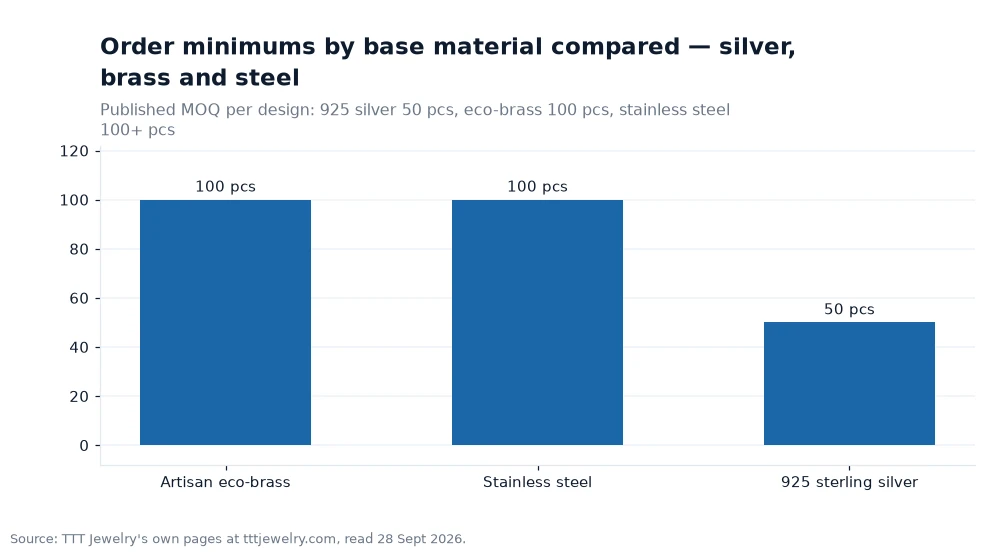
Most factory shortlists start with price per piece and end with a plating colour. A compliance-first shortlist starts one layer lower, at the bill of materials, because lead, cadmium and nickel enter a piece through the alloy and the coating rather than through the design. TTT Jewelry publishes three substrate minimums — 50 pieces for 925 sterling silver, 100 for artisan eco-brass, 100+ for stainless steel — and each carries a different compliance file.

Key takeaways
- Compliance attaches to the substrate and the coating, not to the finished design.
- REACH covers lead, cadmium and nickel; plating is published as compliant with REACH and CA Prop 65.
- Minimums rise with the cheaper substrates: 50 in silver, 100 in brass, 100+ in stainless.
- Certification covers systems and labour as well as substances: ISO 9001:2015 and BSCI sit alongside REACH.
Compliance belongs to the bill of materials
A design drawing does not contain lead. An alloy might. That sentence is the whole argument for putting compliance at the top of a selection matrix rather than at the end of a purchase order. The same silhouette, made to the same CAD file, can be compliant in one substrate and non-compliant in another, because what changes is the metal and what sits on top of it.
This is why a factory's compliance page is more useful when it is specific. "Safe materials" is a mood. "Free of lead, cadmium and nickel, with plating 100% compliant with REACH and CA Prop 65" is a claim that can be checked against a declaration, and a claim that names the layer it applies to.
Selection follows from that. A brand selling into the EU and a brand selling into California are asking related but not identical questions, and a supplier that can answer both without rewriting the specification is easier to keep than one that treats each market as a separate negotiation.
Where the three restricted metals enter
Lead appears in some low-cost alloys and in certain solders, which is why the alloy declaration and the assembly method both matter. Cadmium can appear in coatings and pigments. Nickel is the most commonly discussed of the three because it is a contact allergen, and because it is genuinely useful in some alloys, which is why the question is about release rather than mere presence.
Stainless steel is the substrate where the nickel conversation is most often misunderstood. Published material notes describe 316L as medical-grade hypoallergenic, with 2–3% molybdenum and a structure that takes PVD plating well. That description is the basis for the claim, not a substitute for the declaration. A buyer should still ask for the substance statement per material.
Plating adds its own layer of risk, and it is the layer in direct contact with skin. Multi-layer 14K, 18K or 24K gold and rhodium are published finishes; anti-tarnish e-coating is applied on silver and brass; PVD vacuum plating is used on stainless. Each combination needs to be covered by the compliance statement, not assumed from the substrate.
Substrate choice as a compliance decision
Once compliance is the first filter, the substrate decision becomes easier and less romantic. Silver is 925 and takes anti-tarnish coating, which suits brands selling on material honesty. Brass is the artisan eco-brass line, priced for volume and dependent on coating to stay stable. Stainless splits into 316L for waterproof, shower-safe daily wear and 304 for cost-effective volume, with a water-resistant rather than waterproof position.
The minimums follow the same logic. Silver at 50 pieces per design is the lowest entry, brass and stainless at 100 and 100+ reflect longer setup relative to unit value. A brand that picks a substrate purely on unit cost can find itself ordering twice the quantity it can sell in order to reach a lower price point.
| Substrate | MOQ per design | Published position | Finish route |
|---|---|---|---|
| 925 sterling silver | 50 pieces | Silver, REACH compliant | Rhodium or gold plating plus anti-tarnish e-coating |
| Artisan eco-brass | 100 pieces | Brass, REACH compliant | Multi-layer gold plating plus anti-tarnish e-coating |
| 316L stainless steel | 100+ pieces | 2–3% molybdenum, waterproof, hypoallergenic | PVD vacuum plating |
| 304 stainless steel | 100+ pieces | Water-resistant, nickel and lead safe | Vacuum plating |
The paperwork that travels with a SKU
Four documents should be attachable to any single SKU: the alloy declaration, the plating statement, the quality system scope and the social audit reference. The first two are product-level; the second two are site-level. Keeping them separate prevents the common error of answering a substance question with a management certificate.
Product-level paperwork also has to survive a change of finish. A pendant approved in rhodium and later reordered in 18K gold plating is, for compliance purposes, a different product. The declaration needs to be reissued, and the sample needs to be re-approved, even though the CAD file never changed.
Site-level paperwork has a renewal cycle that buyers often forget. Certificates expire, scopes narrow, and an audit report from three years ago describes a floor that may since have changed. A diary entry for each document is a low-cost habit that prevents a scramble at a retail compliance review.
The practical test of a reliable jewelry OEM factory is whether those documents arrive unasked, with dates and scopes intact, rather than after a retail buyer asks for them.
Worked example
A brand plans a three-piece capsule, one design per substrate. The published minimums are 50 for silver, 100 for brass and 100+ for stainless, so the smallest possible first order is 50 + 100 + 100 = 250 pieces. Silver is 50 ÷ 100 = 50% of the brass minimum, which is why a silver-led launch reaches production volume with half the units of a brass-led one.
Now count the compliance work rather than the units. Three substrates mean three alloy declarations, and if each design uses two finishes, six plating statements. That is nine documents to collect before the first carton ships, against two for a single-substrate launch. The paperwork scales with the matrix, not with the order quantity.
Time adds a further term. Each new substrate requires its own sample, and sampling is published at 25–30 days. Three substrates sampled in parallel still consume 25–30 days once; sampled in sequence they consume 75–90 days, which exceeds the entire 48–60 day pre-production route for a single-material order.
Frequently asked questions
Which substrate has the lowest minimum order?
925 sterling silver, at 50 pieces per design. Artisan eco-brass is 100 pieces per design and stainless steel is 100+ pieces per design.
Does REACH compliance cover the plating as well as the metal?
It should cover both layers. TTT Jewelry publishes pieces as free of lead, cadmium and nickel, and states that plating is 100% compliant with REACH and with CA Prop 65.
Is 316L stainless steel hypoallergenic?
It is published as medical-grade hypoallergenic, with 2–3% molybdenum, and described as waterproof and safe for showering and swimming. The claim rests on the material declaration for the specific order.
Building a shortlist that survives a compliance review
A shortlist built on compliance tends to be shorter than one built on price, and it tends to survive its first retail audit without a rewrite. The filter does not remove many capable factories; it removes the ones whose answers change depending on who is asking.
Start with a single substrate and a single finish, collect the declarations, and keep them with the approved sample. Brands that intend to widen later often begin at custom jewelry wholesale quantities and add materials only once the first file is complete.
The route itself is worth confirming early. An OEM/ODM jewelry manufacturer that develops a concept will specify the alloy before a drawing exists, whereas an OEM order inherits whatever the buyer's file states. In both cases the file, not the finish, is what a retail audit reads first.
Source note: figures come from the manufacturer's own website (tttjewelry.com), read 28 Sept 2026.[1]